
It's ten past seven on a school morning. Your seven-year-old is dressed, mostly. Their bed looks like a storm passed through, the cereal bowl is still on the table, and the school bag is somewhere under a coat. None of this is a crisis. It's a sign that seven is exactly the age to hand over a few real jobs, because a child who can read a chapter book can also learn to clear a bowl and pack a bag.
This guide lists the chores a seven-year-old can realistically do, where that list comes from, how many to start with, and how to keep it going past week two. There's a free printable chart further down.
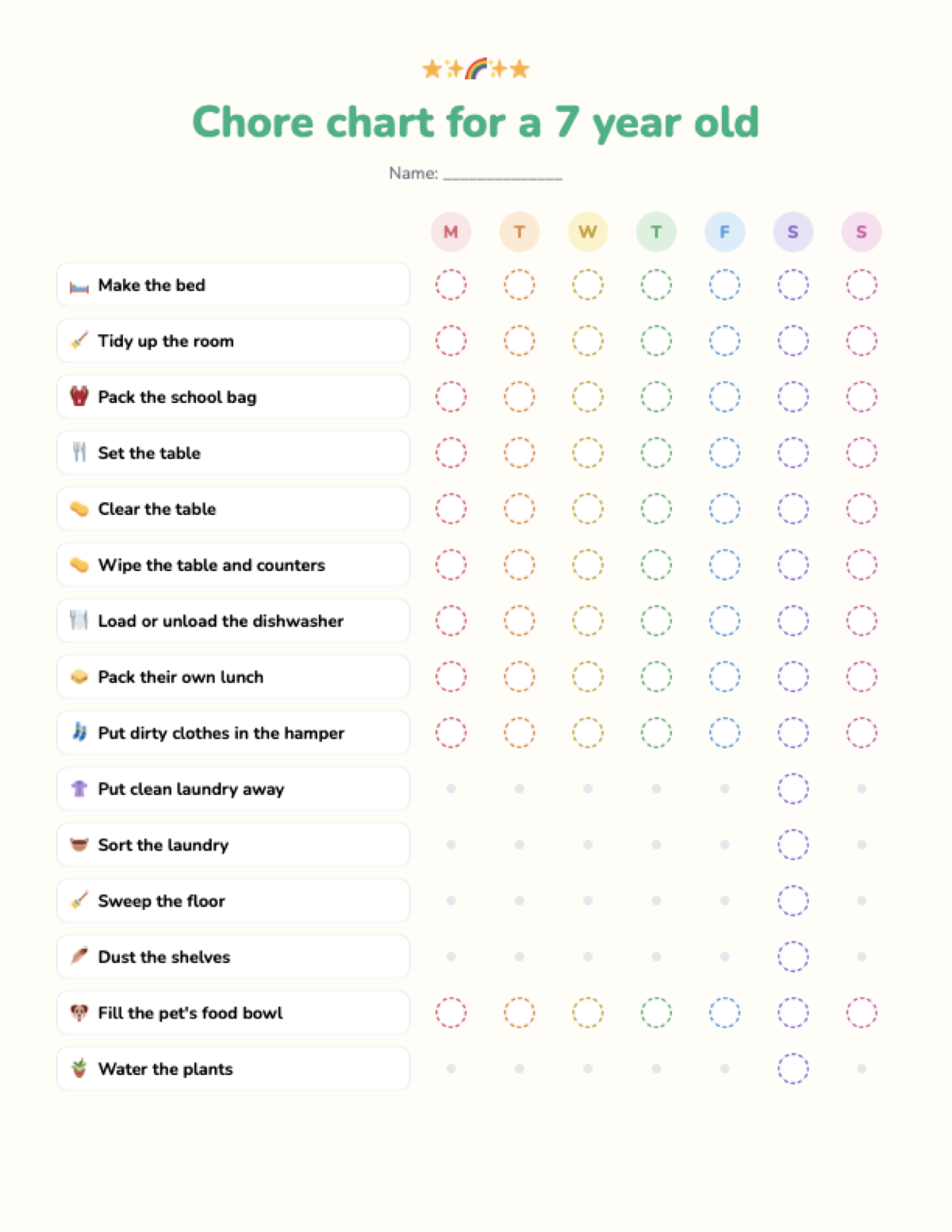
What a 7 year old can do (and why)
Seven is a turning point. Children at this age can follow a few steps in a row, remember a routine without being told every day, and they usually like being trusted with something "grown up". Their hands are steady enough for a cloth, a broom or a stack of plates, but they still need an adult for heat, sharp knives and anything heavy.
Two medical bodies publish age lists we lean on:
- The American Academy of Pediatrics (AAP) groups ages 5 to 7 together: making their own bed, setting and clearing the table, weeding and raking, making and packing school lunches, dusting, putting toys away, tidying bookshelves, putting dirty clothes in the hamper, filling the pet's food dish, emptying wastebaskets, sweeping, sorting laundry, bringing in the mail, watering flowers and washing plastic dishes in the sink (HealthyChildren.org, AAP).
- The American Academy of Child and Adolescent Psychiatry (AACAP) says 6 to 7 year olds can wipe tables and counters, put laundry away and sweep floors, and that 7 to 9 year olds can load and unload the dishwasher, help with meals and pack their own lunch for school (AACAP Facts for Families No. 125).
So a seven-year-old sits right where those two lists meet. They can do everything from the 5 to 7 list, and they are ready to start on the dishwasher and their own lunch.
The list: chores for a 7 year old
Here's the full set, grouped the way a family day actually runs. You don't need all of them. Pick a few from different groups.
Their own things
- Make the bed (it doesn't need to look like a hotel)
- Tidy up their room before dinner
- Put dirty clothes in the hamper and clean laundry away
- Tidy the bookshelf once a week
- Pack the school bag the evening before
Kitchen and meals
- Set the table and clear their own place
- Wipe the table after meals
- Wash plastic dishes at the sink
- Start loading or unloading the dishwasher, with a first few supervised rounds
- Pack their own lunch (you check the lunchbox, they fill it)
Around the house
- Dust shelves once a week
- Sweep the kitchen floor
- Empty the small wastebaskets into the main bin
- Bring in the mail
Pets, plants and outdoors
- Fill the pet's food bowl
- Water the plants
- Rake leaves or pull weeds together with you
Daily routine
Brushing teeth, a bath or shower, brushing hair and laying out tomorrow's clothes aren't chores in the classic sense. They are still the tasks Raccoon parents add most often for this age, and they are where a lot of morning stress comes from. Counting them as "jobs" for a few weeks is a good way to turn them into habits.
How many chores should a 7 year old have?
Less than you think. The AAP's advice for this age is to avoid overloading children while still giving them a real share of the work, and to expect progress, not perfection (HealthyChildren.org).
A setup that works for most families:
- Two or three daily chores. Short and tied to a moment in the day: make the bed after getting dressed, clear the plate after dinner, pack the bag before bed.
- One or two weekly chores. A bigger job on a set day: sort the laundry on Saturday, dust the shelves on Sunday.
- One "learning" chore. Something new that you do together for a few weeks, like loading the dishwasher, until they can do it alone.
When a chore has run smoothly for a month, add the next one. If the whole system starts wobbling, cut back instead of adding reminders.
Making it stick past week two
Seven-year-olds start strong and then fade, which is normal. Both the AAP and the AACAP point at the same few habits that keep chores going:
- Be specific. "Clean your room" is vague. "Books on the shelf, clothes in the hamper, toys in the box" is a job a seven-year-old can finish and check. AACAP calls this setting clear and reasonable expectations.
- Same time, every day. Chores tied to a routine ("after breakfast", "before screen time") need far fewer reminders than chores that float.
- Praise the effort, not the result. A lumpy bed made by the child beats a perfect bed you remade behind their back. If you redo their work, they learn it didn't count.
- Show progress. AACAP suggests a star chart or reward system with specific goals. Seeing the week fill up is motivating in itself, for children and parents.
- Do it alongside them at first. Folding laundry together, then side by side, then alone, is how most skills transfer at this age.
There's also a longer-term reason to keep going. A 2022 study of 207 children aged 5 to 13 found that kids who did more self-care and family-care chores (making a meal for themselves or for someone else, for example) scored better on working memory and self-control, even after accounting for age. It's one survey of parents and can't show that chores cause the difference, but it matches what many parents see (Tepper, Howell and Bennett, 2022).
Chores for 7 year olds to earn money
Many parents search for this, and there's no single right answer. Two approaches work:
- Everyday chores are unpaid, extras earn money. Making the bed and clearing your plate are part of living in a family. Washing the car or raking the whole yard earns something.
- Chores earn points, points buy rewards. The child collects points for the agreed chores and trades them for things you have chosen together: extra screen time, a later bedtime on Friday, a trip for ice cream, or a small amount of pocket money.
For a sense of scale, the kids' money app Greenlight reported that children aged 5 to 8 using its app received about $6.66 a week in allowance in 2025 (Greenlight). That's one company's customer data, not a national average, so treat it as a rough reference. Our guide on allowance for chores goes deeper into amounts and rules.
How Raccoon fits in
Raccoon Kids is a chore app for families: parents set up chores with a coin value, children check them off, and a photo of the finished job can be sent for approval. Children save their coins and trade them for rewards you define, from screen time to a movie night. The age-based presets in the app are built from the same research as this list, so the chores above are one tap away when you set up a seven-year-old.
You don't need an app to use this list. The printable chart above works on the fridge. If you prefer a digital chart that reminds everyone and keeps score, you can try Raccoon for free.
Other ages
Chores grow with your child. For the full picture from toddlers to teens, see our chore chart by age. If motivation is the problem rather than the list, start with how to get kids to do chores.
Sources
- American Academy of Pediatrics, Age-Appropriate Chores for Children, HealthyChildren.org, adapted from Caring for Your School-Age Child: Ages 5 to 12, updated February 2024.
- American Academy of Child and Adolescent Psychiatry, Chores and Children, Facts for Families No. 125, updated June 2018.
- Tepper, D. L., Howell, T. J. and Bennett, P. C. (2022). Executive functions and household chores: Does engagement in chores predict children's cognition? Australian Occupational Therapy Journal, 69(5), 585 to 598.
- Greenlight, Average weekly allowance by age, company data for 2025.