
Your ten-year-old can explain the rules of a video game with more detail than a tax lawyer, remembers every promise you made in March, and still leaves wet towels on the bathroom floor. That gap is the whole point of chores at this age. The skills are there. What's missing is the habit of using them without being asked.
This guide covers what ten-year-olds can realistically take on, where those age recommendations come from, and how to set up a list that runs without daily negotiations. The free printable chart is further down.
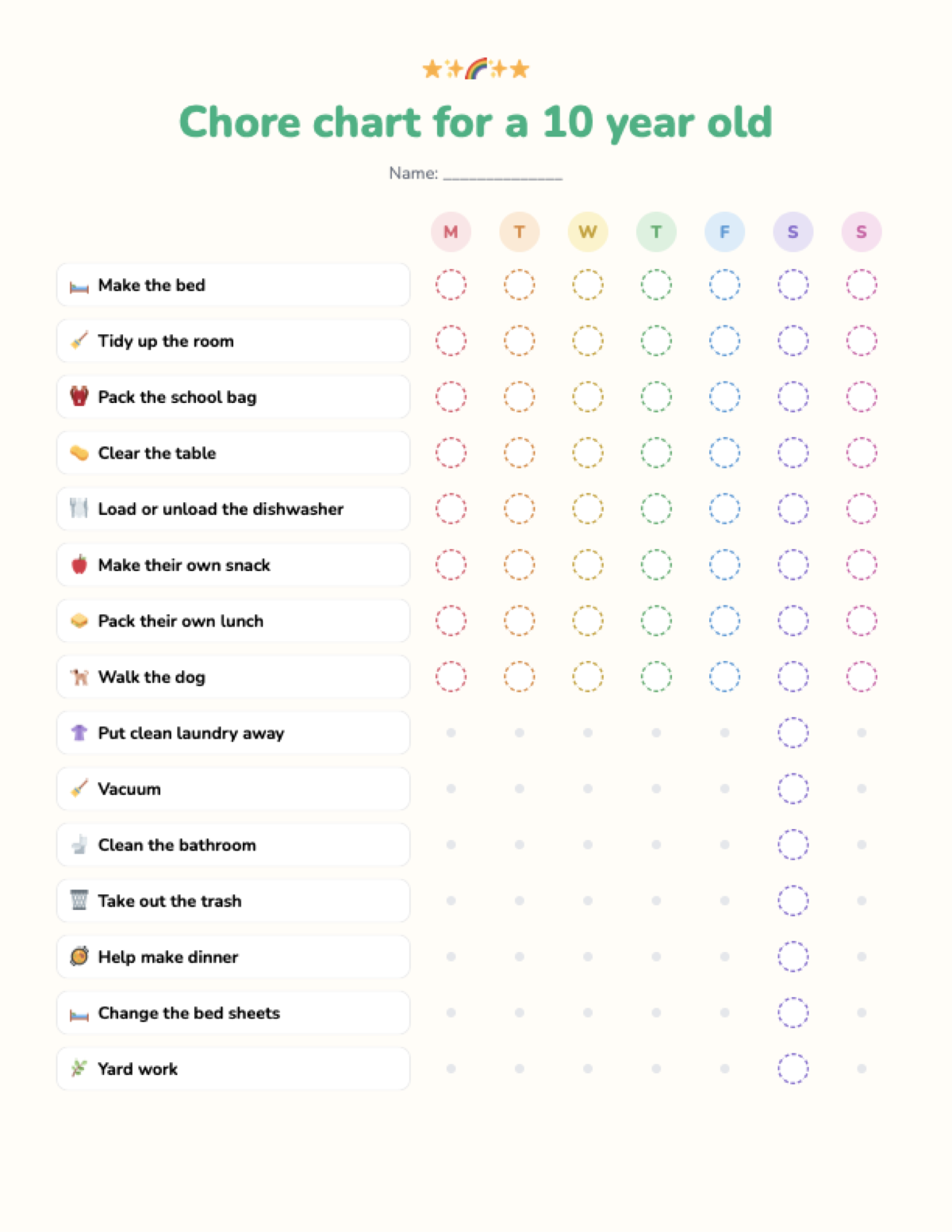
What changes at 10
Around ten, most children can plan a job with a few steps, remember it until it's done, and judge whether it's actually finished. They're stronger and taller, so the kitchen counter, the vacuum and the laundry basket are no longer a stretch. That's why the medical guidance steps up here:
- The American Academy of Pediatrics lists everything from the 5 to 7 list for ages 8 to 10, "plus vacuum, help make dinner, make their own snacks, take a pet for walk, put away their own laundry and put away groceries" (HealthyChildren.org, AAP).
- The American Academy of Child and Adolescent Psychiatry says 10 to 11 year olds can change their sheets, clean the kitchen or bathrooms and do yard work (AACAP Facts for Families No. 125).
A ten-year-old sits at the top of the first list and the start of the second. That's the sweet spot: old enough for real cleaning, young enough to still enjoy being trusted with it.
The list: chores for a 10 year old
Pick from different groups rather than stacking one kind of job.
Their room and their things
- Make the bed every morning
- Tidy their room before dinner
- Put their own clean laundry away
- Change their bed sheets every other week
- Pack the school bag the night before
Kitchen
- Set and clear the table
- Load or unload the dishwasher
- Wipe the table and counters
- Make their own after-school snack
- Pack their own lunch
- Help make dinner once a week (washing, measuring, stirring, setting out ingredients)
- Put the groceries away
Cleaning
- Vacuum their room, later the shared rooms
- Sweep the kitchen floor
- Dust the shelves
- Clean the bathroom sink and mirror, then the whole bathroom with some practice
- Empty the wastebaskets and take the trash out
Pets and outdoors
- Feed the pet and walk the dog
- Water the plants
- Rake leaves, pull weeds and help in the yard
A realistic weekly setup
A good list for this age has three layers:
- Daily, under five minutes each. Make the bed, clear their place, load their dishes, pack the bag. These build the "I just do it" habit.
- Weekly, a real job. Vacuum their room on Saturday, clean the bathroom sink on Sunday, change the sheets every other week. Give each one a fixed day.
- One family contribution. Helping make dinner once a week, walking the dog after school, or putting the groceries away. This is the job that shows them the household runs because everyone chips in.
That usually adds up to four to six chores. The AAP's advice is to avoid overloading, still give children a real share, and expect progress rather than perfection. If a new chore has run smoothly for a month, add the next one.
Teaching the bigger jobs
Ten-year-olds can clean a bathroom or vacuum a room well, but only after someone has shown them what "done" looks like. A few things that help:
- Break it into a checklist. "Clean the bathroom" becomes: spray and wipe the sink, wipe the mirror, wipe the toilet seat and outside, empty the bin. A written checklist on the inside of a cabinet door is worth a hundred reminders.
- Do it together, then side by side, then alone. Two or three rounds of each is usually enough at this age.
- Keep the chemicals simple. One mild all-purpose cleaner and a cloth is plenty. Keep strong products and anything mixed out of reach.
- Check the result, not the method. If the mirror's clean, it doesn't matter that they did it their own way.
The AACAP's list of tips starts with the same idea: set clear and reasonable expectations, and tell your child exactly what needs to be done.
If multi-step jobs are hard for your child
Some ten-year-olds, including many with ADHD, find it hard to start or finish a job with several steps. That's not laziness. A few adjustments usually help more than reminders: a short visual checklist, one step at a time, a timer ("how much can you tidy in five minutes?"), and doing the chore at the same time every day. Your pediatrician can help if chores are a constant battle.
There's also some evidence that everyday chores train exactly these skills. A 2022 study of 207 children aged 5 to 13 found that kids who did more self-care and family-care chores, like making a meal for themselves or someone else, had better working memory and self-control scores, after accounting for age. It was a parent survey, so it can't prove the chores caused the difference, but it's an encouraging link (Tepper, Howell and Bennett, 2022).
Safety at 10
A ten-year-old can do a lot, and there are still a few hard lines:
- Lawn mowers: the AAP recommends at least 12 for a walk-behind mower and 16 for a ride-on mower, and keeping younger children away from mowers entirely (HealthyChildren.org).
- The stove and oven: helping make dinner means washing, measuring and stirring with you in the kitchen. Cooking on their own comes later.
- Knives: a butter knife for spreading or a child-safe knife for soft food is fine; sharp knives stay with an adult for now.
Chores for 10 year olds to earn money
At ten, a lot of kids start asking for their own money. Two setups work well:
- Base chores are unpaid, extras earn money. Making the bed and clearing the table are part of family life. Washing the car or a big yard job earns something extra.
- Chores earn points, points buy rewards. Kids collect points for the agreed chores and trade them for rewards you've chosen together: extra screen time, a later bedtime on Friday, picking the weekend outing, or some pocket money.
As a reference point, Greenlight reported that kids aged 9 to 11 using its app received about $8.58 a week in allowance in 2025 (Greenlight). That's one company's customer data, not a national average. A lot of families simply use "$1 per year of age" as a starting point. Our guide on allowance for chores goes deeper into amounts and rules, and screen time as a reward covers the most popular non-money option.
How Raccoon fits in
Raccoon Kids is a chore app for families: you set up chores with a coin value, your child checks them off, and they can snap a photo of the finished job for you to approve from anywhere. Kids save their coins and trade them for rewards you choose. The age-based presets in the app are built from the same research as this list, so a ten-year-old's chores are ready to add in a couple of taps.
The printable chart works perfectly well on its own. If you'd rather have the list, the reminders and the coin count in one place, you can try Raccoon for free.
Other ages
See the full chore chart by age for toddlers to teens, or jump to chores for 7 year olds if you're setting up a younger sibling at the same time. If the list isn't the problem but the follow-through is, read how to get kids to do chores.
Sources
- American Academy of Pediatrics, Age-Appropriate Chores for Children, HealthyChildren.org, adapted from Caring for Your School-Age Child: Ages 5 to 12, updated February 2024.
- American Academy of Child and Adolescent Psychiatry, Chores and Children, Facts for Families No. 125, updated June 2018.
- American Academy of Pediatrics, Lawn Mower Safety: Information for Families, HealthyChildren.org.
- Tepper, D. L., Howell, T. J. and Bennett, P. C. (2022). Executive functions and household chores: Does engagement in chores predict children's cognition? Australian Occupational Therapy Journal, 69(5), 585 to 598.
- Greenlight, Average weekly allowance by age, company data for 2025.