
Six-year-olds are proud of being "big". They've started school, they can tie their shoes (on a good day), and they want jobs that feel important. If you hand one a cloth and say "this table is yours after dinner", there's a good chance they'll wipe it with full concentration, including the chair and part of the wall. That enthusiasm is the best reason to start chores now, before helping becomes something to negotiate.
This guide lists the chores a six-year-old can really do, what the pediatric guidance says, and how to keep it light enough that it lasts. The free printable chart is further down.
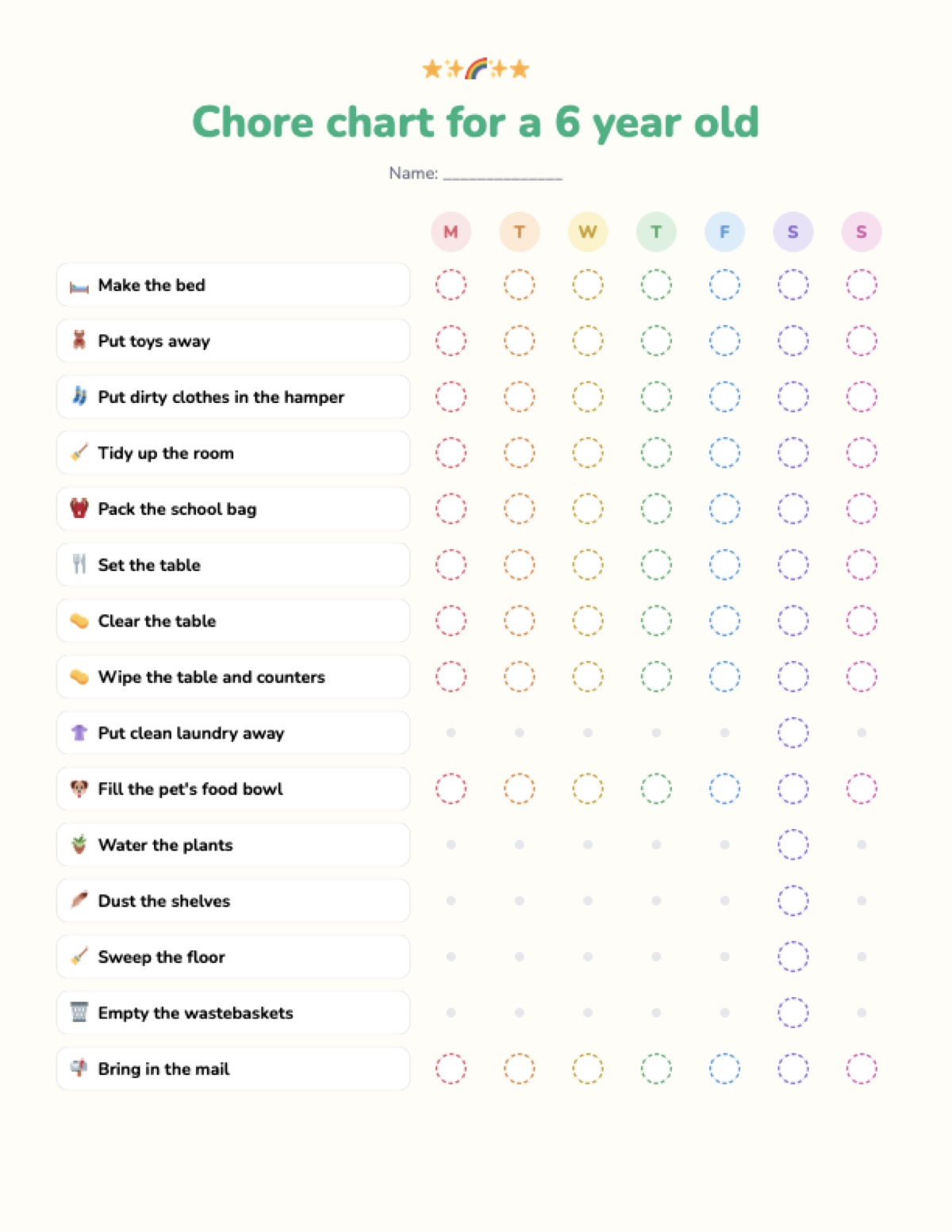
What a 6 year old is ready for
At six, most children can follow a short routine, carry a stack of plates with two hands, and remember one job without being told every day. Their attention span is still short, so the best chores are quick, visible and finished in a few minutes.
Two medical bodies publish age lists that fit this stage:
- The American Academy of Pediatrics groups ages 5 to 7: making their own bed, setting and clearing the table, putting toys away, tidying bookshelves, putting dirty clothes in the hamper, filling the pet's food dish, emptying wastebaskets, dusting, sweeping, sorting laundry, bringing in the mail, watering flowers and washing plastic dishes in the sink (HealthyChildren.org, AAP).
- The American Academy of Child and Adolescent Psychiatry says 6 to 7 year olds can wipe tables and counters, put laundry away and sweep floors (AACAP Facts for Families No. 125).
Six is the start of both lists, so think "learning" rather than "doing it all". Pick a few, teach them well, and add more over the year.
The list: chores for a 6 year old
Their own things
- Make the bed (a pulled-up duvet counts)
- Put toys away before dinner or bedtime
- Put dirty clothes in the hamper
- Put clean laundry in their drawer
- Tidy the bookshelf
- Pack the school bag with you the evening before
Kitchen
- Set the table (plates, cups, cutlery)
- Clear their own place after meals
- Wipe the table
- Wash plastic dishes in the sink
Around the house
- Dust a shelf with a dry cloth
- Sweep with a small broom and dustpan
- Empty the small wastebaskets into the big bin
- Bring in the mail
Pets and plants
- Fill the pet's food bowl
- Water the plants
Daily routine
Brushing teeth, getting dressed, bath time and picking tomorrow's outfit aren't classic chores, but they're among the tasks Raccoon parents add most often at this age, and they're where many mornings go wrong. Putting them on the chart for a few weeks turns them into habits.
Keep it small
For a six-year-old, less is more:
- Two or three daily chores. Tiny, tied to a moment: bed after getting dressed, plate to the sink after dinner, toys in the box before bath.
- One weekly chore. Watering the plants on Saturday or dusting their shelf on Sunday.
- Teach, then hand over. Do each new chore together for a week or two before it's theirs alone.
The AAP puts it simply: don't expect perfection, praise the effort, avoid overloading, and be consistent. A chart or checklist helps make chores the norm rather than the exception.
How to teach setting the table
Setting the table is a great first "real" job at six. It happens every day, it's easy to check, and the whole family sees it. Here's one way to teach it over a couple of weeks:
- Start with one item. For the first few days, your child puts out only the plates. Then the cups. Then the cutlery. One new item every few days keeps it easy.
- Show where things go. Fork on the left, knife and spoon on the right. Some families draw a place setting on a sheet of paper and use it as a placemat, so the map is right there.
- Count together. "How many people are eating tonight?" Counting plates is sneaky math practice, and it prevents the "I forgot Dad" moment.
- Keep the heavy and the hot for you. Your child does plates, cups and cutlery. Serving dishes and full jugs stay with an adult for now.
- Give it a fixed moment. Same time every day, like when you start cooking. After a while, "dinner's in ten minutes" becomes the signal on its own.
Once they've got it, let them add a finishing touch of their own, like folded napkins or a drawing for each place. Six-year-olds love a job that shows. And if the forks end up on the wrong side, eat anyway. The table is set.
Making chores fun (and fight-free)
Six-year-olds do their best work when it feels like play. A few ideas that parents swear by:
- Beat the timer. "How many toys can you put away before this song ends?" turns tidying into a race.
- Pictures on the chart. Many six-year-olds can't read every word yet. An emoji or small drawing next to each chore makes the chart theirs.
- Be their helper, not their boss. Wiping the table together, then side by side, then alone is how the skill transfers.
- Show progress. The AACAP recommends a star chart or reward system with specific goals. A sticker or coin for every finished job is exactly that.
- Don't redo their work in front of them. A slightly crooked table setting still counts. Next time, show one small improvement.
There's also a longer-term payoff. A 2022 study of 207 children aged 5 to 13 found that kids who did more self-care and family-care chores had better working memory and self-control scores, after accounting for age (Tepper, Howell and Bennett, 2022). It was a survey of parents, so it can't prove chores caused the difference, but it's a nice link.
Chores for 6 year olds to earn money
Plenty of parents search for this, and at six the answer usually isn't "cash for every chore". Two setups that work at this age:
- Stickers or coins for everyday chores, rewards on top. Your child collects a sticker or coin per job and trades a full row for something small: an extra bedtime story, picking the movie on Friday, or a trip to the playground.
- Small money for extra jobs. Everyday chores stay part of family life, and a bigger "grown-up" job, like helping wash the car, earns a coin for the piggy bank.
If you're curious about amounts, Greenlight reported that kids aged 5 to 8 using its app received about $6.66 a week in allowance in 2025 (Greenlight). That's one company's customer data, not a national average. More on the pros and cons in our guide to allowance for chores.
How Raccoon fits in
Raccoon Kids is a chore app built for exactly this stage: each chore has an icon and a coin value, your child taps it when it's done, and you can approve it with a photo if you like. Coins add up, and your child trades them for rewards you choose, like an extra bedtime story or a movie night. The app's age-based presets come from the same research as this list.
A printed chart on the fridge works just as well for many six-year-olds. If you'd rather have it on a tablet with coins that add up by themselves, you can try Raccoon for free.
Other ages
Planning ahead or setting up siblings? See chores for 7 year olds, chores for 8 year olds, or the complete chore chart by age. For a school-morning checklist, see our morning routine for kids.
Sources
- American Academy of Pediatrics, Age-Appropriate Chores for Children, HealthyChildren.org, adapted from Caring for Your School-Age Child: Ages 5 to 12, updated February 2024.
- American Academy of Child and Adolescent Psychiatry, Chores and Children, Facts for Families No. 125, updated June 2018.
- Tepper, D. L., Howell, T. J. and Bennett, P. C. (2022). Executive functions and household chores: Does engagement in chores predict children's cognition? Australian Occupational Therapy Journal, 69(5), 585 to 598.
- Greenlight, Average weekly allowance by age, company data for 2025.