
Eight is when a lot of parents notice something new. You ask for help with the groceries and your child carries the heavy bag without complaint, then puts the milk in the fridge on their own. The next morning the same child can't find the shoes they took off ten minutes ago. Both are completely normal. Eight-year-olds are ready for real responsibility, as long as the jobs are clear and happen at the same time every day.
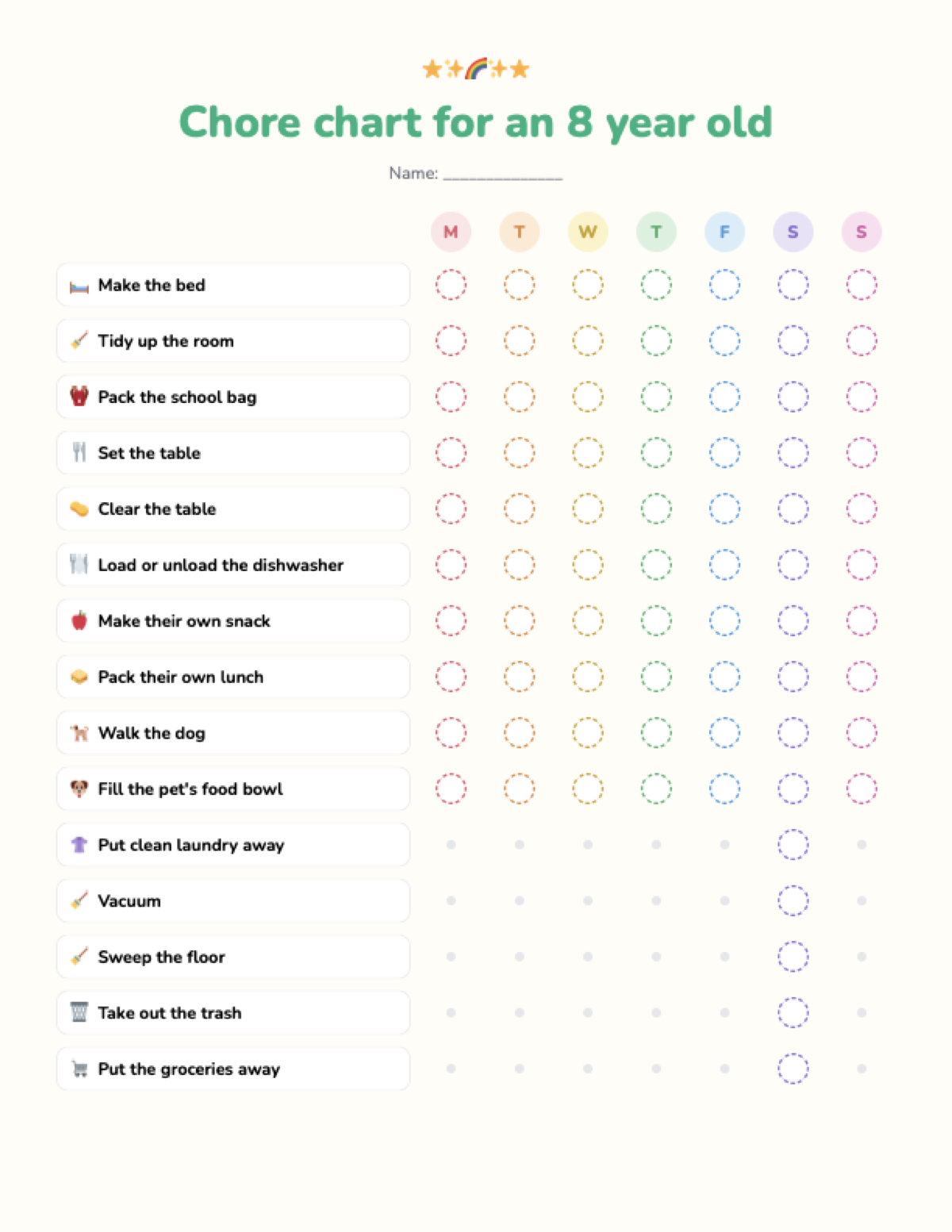
Below you'll find what an eight-year-old can realistically do, the medical guidance behind it, and a free printable chart.
Why 8 is a step up
The American Academy of Pediatrics draws a line at eight. Its list for ages 8 to 10 includes everything from the younger list, "plus vacuum, help make dinner, make their own snacks, take a pet for walk, put away their own laundry and put away groceries" (HealthyChildren.org, AAP).
The American Academy of Child and Adolescent Psychiatry agrees from a slightly different angle. It says 7 to 9 year olds can load and unload the dishwasher, help with meal preparation and pack their own lunch for school (AACAP Facts for Families No. 125).
What's behind the step up: eight-year-olds can hold a sequence in their head ("rinse, stack, close the door"), they're strong enough for a vacuum and a full laundry basket, and they care about doing things "properly". That last part is useful. Show them what a finished job looks like, and many will hold themselves to it.
The list: chores for an 8 year old
Their room and their things
- Make the bed
- Tidy their room and bookshelf
- Put their own clean laundry away
- Pack the school bag the night before
Kitchen
- Set and clear the table
- Load or unload the dishwasher
- Wipe the table and counters
- Make their own snack (no stove)
- Pack their own lunch
- Put the groceries away
- Help make dinner once a week
Around the house
- Vacuum their room
- Sweep the kitchen floor
- Dust the shelves
- Empty the wastebaskets and take the trash out
Pets and outdoors
- Feed the pet and walk the dog (with you at first, depending on the dog and the street)
- Water the plants
- Rake leaves and pull weeds
How many, and how often
Four or five chores is plenty. A structure that works for most eight-year-olds:
- Two or three daily jobs, each tied to a fixed moment: bed after getting dressed, dishwasher after dinner, school bag before screen time.
- One or two weekly jobs on a set day: vacuum their room on Saturday, put the groceries away after the weekly shop.
- One new skill at a time. Pick one of the new 8-to-10 jobs, like making their own snack or vacuuming, and practice it together for a couple of weeks before handing it over.
The AAP's guidance for this age is to avoid overloading, give an appropriate share of the work, be consistent, and use praise and encouragement rather than scolding. A chart helps, too.
How to teach loading the dishwasher
The dishwasher is the AACAP's classic job for this age, and it's one an eight-year-old can own completely once they've learned it. Teach it in stages:
- Start with unloading. It only asks them to know where things live. Begin with the cutlery basket, which is really a sorting game, then plastic cups and bowls, then plates and glasses once they're steady.
- Show your system once, slowly. Plates in the bottom rack, cups and glasses upside down on top, cutlery in the basket. Every dishwasher is a little different, so show them how yours works.
- Give them the steps. Scrape or rinse (whatever your household does), stack, close the door. Saying the steps out loud the first few times helps them stick.
- Sharp knives stay with you. Those are an adult job for now, just like the stove.
- Check together, then step back. For the first week, look at the racks together and fix one thing: "This bowl will fill with water. Can you flip it?" After that, check less and less.
Once it's theirs, give it a fixed moment. "After dinner, the dishwasher" works much better than "when you get a chance". With more than one child, some families split it: one loads in the evening, the other unloads in the morning, and they swap every week.
Making it work with an 8 year old
Eight-year-olds respond well to structure and fairness. These habits help chores stick:
- Write it down. A chart on the fridge settles "you never told me" before it starts. The AACAP suggests a star chart or reward system with specific goals.
- Define "done". "Clean your room" means little. "Clothes in the hamper, books on the shelf, floor clear" is a job they can check themselves.
- Let them choose sometimes. Offer two or three chores and let them pick one. Choice makes the job theirs.
- Keep it fair between siblings. Different ages get different chores, and eight-year-olds notice. Explain that the list grows with age, so the younger sibling's turn will come.
- Praise the effort. If you redo their work, they'll stop trying. Fix it together next time instead.
There's also a nice long-term reason to keep going. A 2022 study of 207 children aged 5 to 13 found that kids who did more self-care and family-care chores had better working memory and self-control scores, after accounting for age (Tepper, Howell and Bennett, 2022). The study was a parent survey, so it can't show that chores caused the difference, but the link is encouraging.
Chores for 8 year olds to earn money
Eight is often when kids start wanting their own money for Pokémon cards, a toy or a gift for a friend. Two setups work well:
- Everyday chores stay unpaid. Making the bed and clearing the table are part of family life. Bigger extras, like washing the car with you or clearing out the toy closet, can earn money.
- Points first, then rewards. Chores earn points, and points buy rewards you pick together: extra screen time, choosing dinner, a trip for ice cream, or some pocket money.
For a sense of scale, Greenlight reported that kids aged 5 to 8 using its app received about $6.66 a week in allowance in 2025 (Greenlight). That's one company's customer data, not a national average. Our guide on allowance for chores covers amounts and rules in more detail.
How Raccoon fits in
Raccoon Kids turns the chart into an app: you set up chores with a coin value, your child checks them off, and they can send a photo of the finished job for you to approve. Coins go into their balance, and they trade them for rewards you define. The app's age-based presets are built from the same research as this list, so an eight-year-old's chores are a couple of taps away.
The printable chart works fine on its own. If you'd like the reminders and the coin count handled for you, you can try Raccoon for free.
Other ages
Setting up siblings too? See chores for 7 year olds, chores for 10 year olds, or the complete chore chart by age.
Sources
- American Academy of Pediatrics, Age-Appropriate Chores for Children, HealthyChildren.org, adapted from Caring for Your School-Age Child: Ages 5 to 12, updated February 2024.
- American Academy of Child and Adolescent Psychiatry, Chores and Children, Facts for Families No. 125, updated June 2018.
- Tepper, D. L., Howell, T. J. and Bennett, P. C. (2022). Executive functions and household chores: Does engagement in chores predict children's cognition? Australian Occupational Therapy Journal, 69(5), 585 to 598.
- Greenlight, Average weekly allowance by age, company data for 2025.