
Nine is a quietly big year. Your child can read a recipe, follow a two-page instruction sheet for a Lego set, and argue convincingly about why their bedtime should be later. They can also do a surprising amount around the house, and many nine-year-olds like it more than they admit, as long as the job is theirs and nobody takes over halfway.
This page covers what a nine-year-old can realistically handle, where those recommendations come from, and a free printable chart to start with.
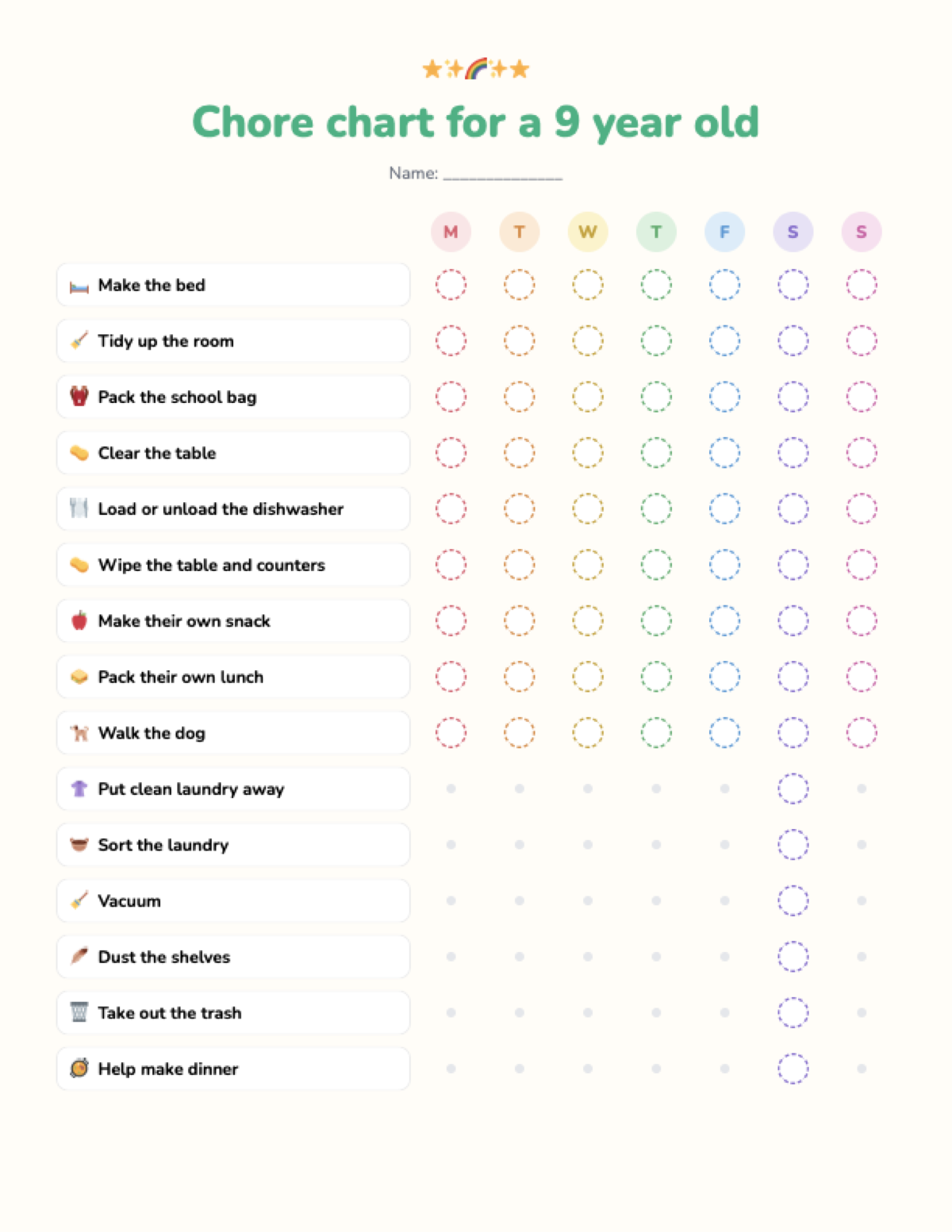
What a 9 year old can take on
At nine, children sit in the middle of two professional age lists:
- The American Academy of Pediatrics' list for ages 8 to 10 adds to the younger chores: vacuuming, helping make dinner, making their own snacks, walking a pet, putting away their own laundry and putting away groceries (HealthyChildren.org, AAP).
- The American Academy of Child and Adolescent Psychiatry says 7 to 9 year olds can load and unload the dishwasher, help with meal preparation and pack their own lunch (AACAP Facts for Families No. 125).
In practice, that means a nine-year-old can own a whole routine, like "after dinner, clear the table, load the dishwasher and wipe the counters", not just a single task. Owning a routine is the real milestone at this age.
The list: chores for a 9 year old
Their room
- Make the bed
- Tidy the room and the bookshelf
- Put clean laundry away and sort the dirty laundry
- Pack the school bag in the evening
Kitchen
- Set and clear the table
- Load or unload the dishwasher
- Wipe the table and counters
- Make their own snack
- Pack their own lunch
- Put the groceries away
- Help make dinner once a week
Around the house
- Vacuum their room
- Sweep and dust
- Empty the wastebaskets, take the trash out
Pets and outdoors
- Feed the pet and walk the dog
- Water the plants, rake and weed
Give them a routine, not a to-do list
The step up at nine is moving from single tasks to small routines:
- Morning routine: make the bed, get dressed, put pajamas away.
- After-school routine: unpack the lunchbox, make a snack, start homework.
- After-dinner routine: clear the table, load the dishwasher, wipe the counters.
- Weekend job: vacuum their room, or help cook one dinner from start to finish with you.
Four to six chores in total is plenty. The AAP recommends giving children an appropriate share of responsibility without overloading them, being consistent, and using praise instead of scolding. A written checklist per routine saves a lot of reminding.
How to teach: helping make dinner
"Help make dinner once a week" is on the list, and it's the chore many nine-year-olds end up loving most. A way to build it up:
- Pick one fixed night. "Tuesday is your night in the kitchen" is much easier to keep than "whenever you want".
- Choose the meal together. Something with a few clear steps: pasta with a simple sauce, tacos, a big salad, a homemade pizza. Let them read the recipe out loud, which is where being nine really pays off.
- Give them the jobs that fit. Measuring, stirring, washing vegetables, grating cheese, setting out the toppings. The stove and sharp knives stay supervised.
- Hand over a whole part. After a few weeks, one part of the meal is theirs from start to finish, like the salad or the garlic bread. You're nearby, but it's their dish.
- Include the cleanup. Clearing the table, loading the dishwasher and wiping the counters is the after-dinner routine they already know.
Let them announce their dish at the table. Being the cook is a big deal at nine, and a proud "I made the salad" is its own reward.
Why it's worth the effort now
Nine-year-olds often start comparing themselves with friends: who has a phone, who gets pocket money, who stays up later. That makes it a good age to connect responsibility with privileges in a calm, predictable way.
There's also research linking everyday chores to useful thinking skills. A 2022 study of 207 children aged 5 to 13 found that children who did more self-care and family-care chores, like preparing a meal for themselves or someone else, had better working memory and self-control scores, after accounting for age. It was a survey of parents, so it shows a link, not proof that chores cause the difference (Tepper, Howell and Bennett, 2022).
When it doesn't work
Even with a good routine, there will be weeks when chores slide. Some common ones, and what you can say:
- "I forgot." Don't argue about whether they did. Point to the checklist instead: "What's on the after-dinner list?" If it keeps happening, the chore probably isn't tied to a fixed moment yet.
- "Why do I have to do more than my brother?" Nine-year-olds are sharp about fairness. "Your list grows as you get older, and so do the things you're allowed to do." Taking turns on shared jobs, like who clears the table, takes a lot of the heat out of the everyday ones.
- Rushed, sloppy work. Walk through it once together: "Counters wiped? Table clear? Dishwasher closed?" Next time, they check their own work against the same questions.
- "I'll do it later." Sometimes later is fine. Agree on a clear later, like "before screen time", and then hold to it calmly.
- You take over. It happens to all of us. If you catch yourself finishing their job, stop and ask "What's left?" instead. Nine-year-olds lose interest fast once a chore stops being theirs.
Chores for 9 year olds to earn money
At nine, some kids are ready to earn toward something specific, like a game or a gift. Two approaches that work:
- Base chores unpaid, extras paid. Routines are part of family life. A bigger one-off job, like cleaning out the garage shelves with you, can earn money.
- Points that turn into rewards. Chores earn points, and your child trades them for rewards you've agreed on: screen time, a later bedtime on Friday, choosing the weekend outing, or pocket money.
As a reference point, Greenlight reported that kids aged 9 to 11 using its app received about $8.58 a week in allowance in 2025 (Greenlight). That's one company's customer data, not a national figure. See our guide on allowance for chores for amounts and ground rules.
How Raccoon fits in
In Raccoon Kids, each chore has a coin value. Your child checks it off, can add a photo as proof, and you approve it from anywhere. Coins add up, and your child spends them on rewards you choose. The app's age-based presets use the same research as this page, so a nine-year-old's routines are quick to set up.
You don't need an app for any of this, and the printable chart works on its own. If you'd like reminders and the coin count handled for you, try Raccoon for free.
Other ages
See chores for 8 year olds, chores for 10 year olds, or the full chore chart by age.
Sources
- American Academy of Pediatrics, Age-Appropriate Chores for Children, HealthyChildren.org, adapted from Caring for Your School-Age Child: Ages 5 to 12, updated February 2024.
- American Academy of Child and Adolescent Psychiatry, Chores and Children, Facts for Families No. 125, updated June 2018.
- Tepper, D. L., Howell, T. J. and Bennett, P. C. (2022). Executive functions and household chores: Does engagement in chores predict children's cognition? Australian Occupational Therapy Journal, 69(5), 585 to 598.
- Greenlight, Average weekly allowance by age, company data for 2025.