










Customize your chart below 👇
1Who's this chart for?
2How old is your child?
This picks starting steps. Change anything below.
3Your steps
Drag to change the order. Tap a picture to swap it.
More ideas
4Pick a look
Share what you made with your friends 💛
Email me the PDF 📬
We'll email you the PDF plus occasional parenting tips. Unsubscribe anytime.
Ready-made bedtime routine charts to print
Start from one of these, then change anything you like.
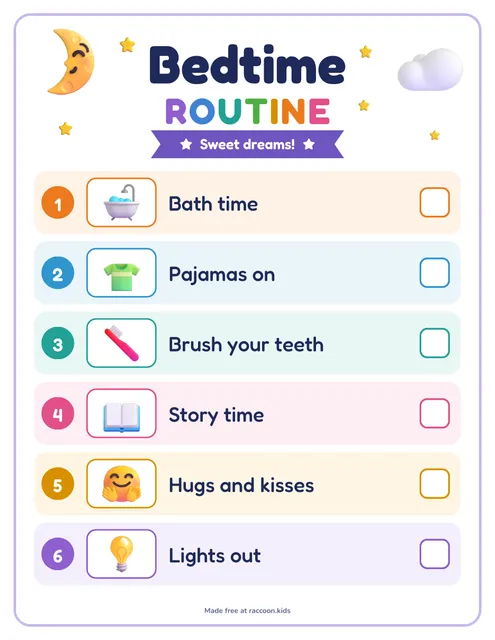 Bedtime routine for toddlersBath, pajamas, teeth, story, cuddles, lights outUse this one
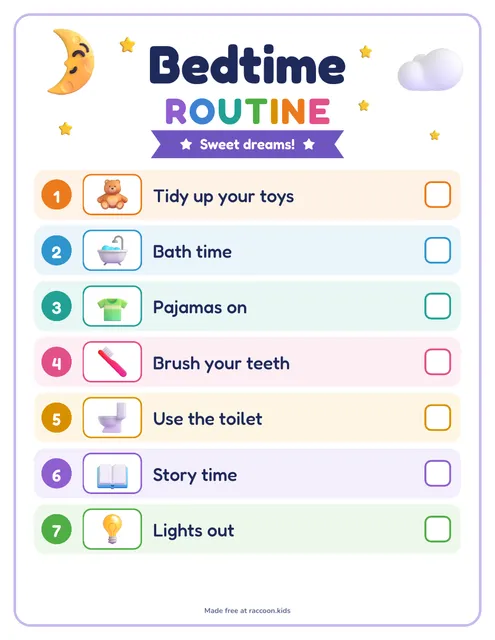 Night time routine chart for preschoolersSeven calm picture steps for ages 4 to 5Use this one
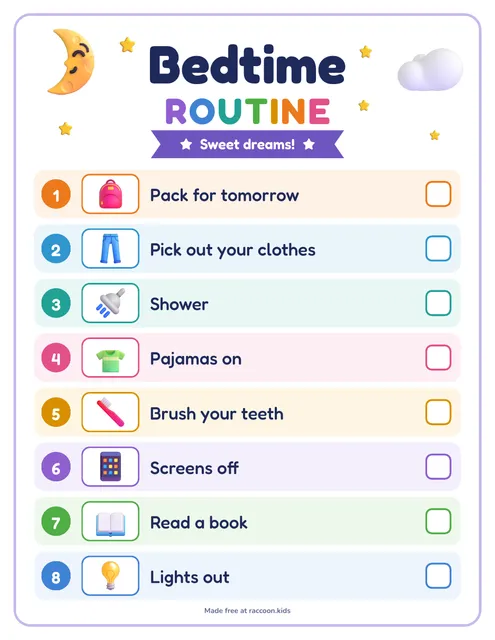 Bedtime checklist for big kidsPack for tomorrow, screens off, read, ages 9 and upUse this one
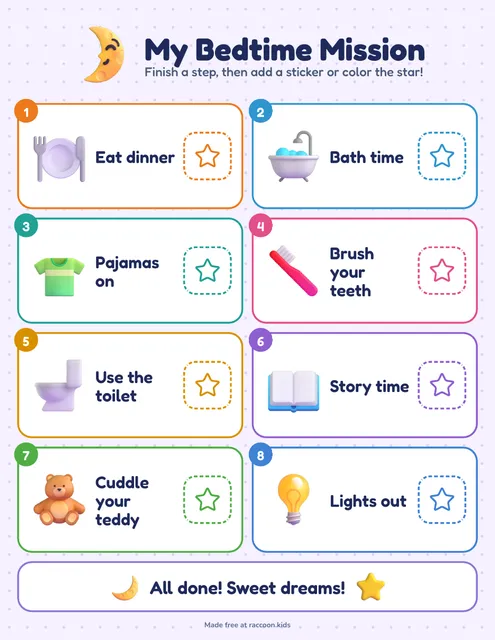 Bedtime routine game boardSticker spots and a sweet-dreams finish, ages 6 to 8Use this one
How to make a bedtime routine chart
- Add a name. The chart wishes your child sweet dreams by name on the ribbon, and kids notice.
- Choose an age. Toddlers get six calm steps from bath to lights out. Older kids get steps they run themselves, like packing for tomorrow and screens off.
- Put the evening in order. Drag the steps until they match what really happens in your house, swap any picture, and add steps from the ideas below the list.
- Print it. Pick checklist rows or the game board and download the PDF. The bedtime routine chart is printable on A4 or Letter, free, with no sign-up.
Hang the bedtime chart where the routine starts, which is usually the bathroom or the bedroom door, low enough for your child to reach.
A night time routine chart for toddlers
Toddlers fight bedtime less when they know exactly what comes next and that it comes in the same order every night. A night time routine chart with pictures lets a 2-year-old "read" the plan: bath, pajamas, teeth, story, cuddles, lights out.
- Short and always the same. Six steps is plenty. The calm comes from repetition, so resist adding new steps every week.
- Let the chart be the boss. "What does the chart say is next?" is a question, not an order, and it moves the negotiation away from you.
- The best step goes last. Story time and cuddles near the end give your child something to move toward instead of away from.
Here are the starting steps for each age, ready to change in the maker above:
- Ages 2 to 3: Bath time, pajamas on, brush your teeth, story time, hugs and kisses and lights out.
- Ages 4 to 5: Tidy up your toys, bath time, pajamas on, brush your teeth, use the toilet, story time and lights out.
- Ages 6 to 8: Eat dinner, bath time, pajamas on, brush your teeth, use the toilet, story time, cuddle your teddy and lights out.
- Ages 9 and up: Pack for tomorrow, pick out your clothes, shower, pajamas on, brush your teeth, screens off, read a book and lights out.
Bedtime checklist, game board or visual schedule
One set of steps, three ways to use it at night:
- Bedtime routine checklist. The sunny rows print a box next to each step. Older kids like ticking them off on their own, and a plastic sleeve plus a dry-erase marker makes one copy last.
- Bedtime game board. Every step is a card with a star to color or a sticker spot, and the board ends with "All done! Sweet dreams!"
- Bedtime routine visual schedule. Prefer cards your child can move? The visual schedule maker prints each step as a picture card to cut out. Line them up on the bedroom door with Velcro dots, and your child moves each card to done.
When bedtime trouble is really one behavior, like staying in bed all night, a sticker chart for that single goal works better than a routine. Try the reward chart maker for that. For the start of the day, make a morning routine chart in the same style, or put the whole day on one page with the daily routine chart.