
















 Sweet dreams!
Customize your chart below 👇
1Who's this chart for?
2How old is your child?
This picks starting steps for the morning, the afternoon and bedtime. Change anything below.
3Your three routines
Drag to change the order. Tap a picture to swap it. Up to 8 steps fit in each part of the day.
 6 of 8
More ideas
 5 of 8
More ideas
 6 of 8
More ideas
4Pick a look
Share what you made with your friends 💛
Email me the PDF 📬
We'll email you the PDF plus occasional parenting tips. Unsubscribe anytime.
Ready-made daily routine charts to print
Start from one of these, then change anything you like.
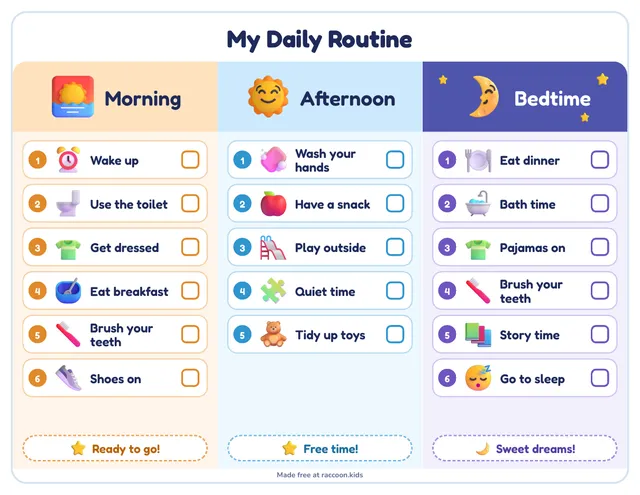 Daily routine chart for preschoolersMorning, afternoon and bedtime in pictures, ages 4 to 5Use this one
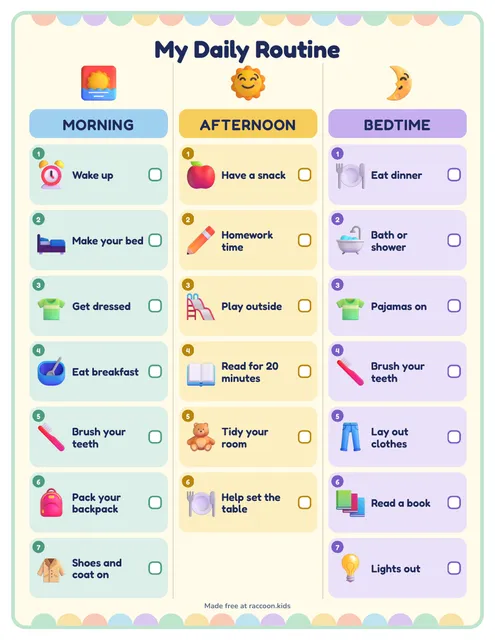 School day routine chartBefore school, after school and bedtime, ages 6 to 8Use this one
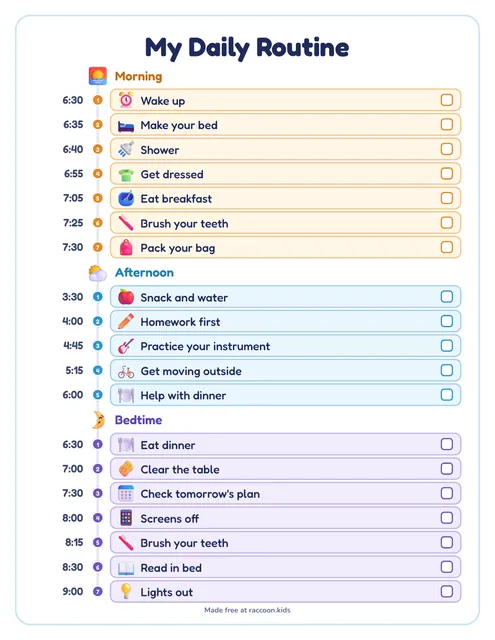 Daily schedule with timesA timeline with clock times for kids who read a clockUse this one
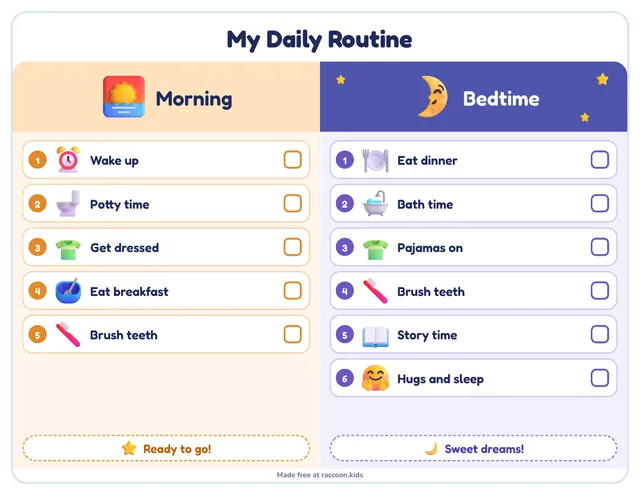 Morning and bedtime routine chartJust the two ends of the day, for toddlersUse this one
How to make a daily routine chart for kids
Most kids don't need more reminders. They need to see what comes next. A daily routine chart puts the whole day on one page: the morning rush, the hours after school and the slow wind-down to bed, each with a picture your child can read before they can read words.
- Add a name. Charts with their own name on top get looked at. The title fills in by itself.
- Pick an age. You get starting steps for all three parts of the day, sized for a toddler, a preschooler, a school kid or a tween.
- Make it yours. Rename steps, swap pictures, drag them into the order your day really runs, and add times if your child reads a clock. Up to 8 steps fit in each part.
- Pick a look and print. Three skies in landscape, three columns or a timeline with times. Download the free printable routine chart as a PDF on A4 or Letter, or email it to yourself.
What goes on a visual routine chart at each age
A visual routine chart works when every step is something your child can do on their own, in the order it happens. These are the starting steps the maker loads for each age. Treat them as a draft, not a rule.
Ages 2 to 3
- Morning: Wake up, Potty time, Get dressed, Eat breakfast, Brush teeth
- Afternoon: Eat lunch, Nap time, Have a snack, Play outside, Tidy up toys
- Bedtime: Eat dinner, Bath time, Pajamas on, Brush teeth, Story time, Hugs and sleep
Ages 4 to 5
- Morning: Wake up, Use the toilet, Get dressed, Eat breakfast, Brush your teeth, Shoes on
- Afternoon: Wash your hands, Have a snack, Play outside, Quiet time, Tidy up toys
- Bedtime: Eat dinner, Bath time, Pajamas on, Brush your teeth, Story time, Go to sleep
Ages 6 to 8
- Morning: Wake up, Make your bed, Get dressed, Eat breakfast, Brush your teeth, Pack your backpack, Shoes and coat on
- Afternoon: Have a snack, Homework time, Play outside, Read for 20 minutes, Tidy your room, Help set the table
- Bedtime: Eat dinner, Bath or shower, Pajamas on, Brush your teeth, Lay out clothes, Read a book, Lights out
Ages 9 and up
- Morning: Wake up, Make your bed, Shower, Get dressed, Eat breakfast, Brush your teeth, Pack your bag
- Afternoon: Snack and water, Homework first, Practice your instrument, Get moving outside, Help with dinner
- Bedtime: Eat dinner, Clear the table, Check tomorrow's plan, Screens off, Brush your teeth, Read in bed, Lights out
A morning and bedtime routine chart, or the whole day?
One routine chart for the whole day is great when the same few steps trip you up every morning and every night. You see the full day at a glance and so does your child. A few ways to bend it to your family:
- Just mornings and bedtime. Remove every afternoon step and that part drops off the page, which leaves a morning and bedtime routine chart with bigger rows.
- A printable blank routine chart. Clear the text of a step and it prints as a line to write on, so you can fill the chart in by hand with your child.
- One routine on its own page. If only one part of the day is the hard part, make a morning routine chart, an after school checklist or a bedtime routine chart with room for 12 steps.
- Cards to move around. The visual schedule maker prints every step as a picture card to cut out, plus a board with a To do and an All done side.
Hang the chart at your child's eye level, where the routine happens, and let them tick the boxes themselves. For the school-morning side of things, our guide to a morning routine for kids walks through the steps that end the 7 a.m. scramble.